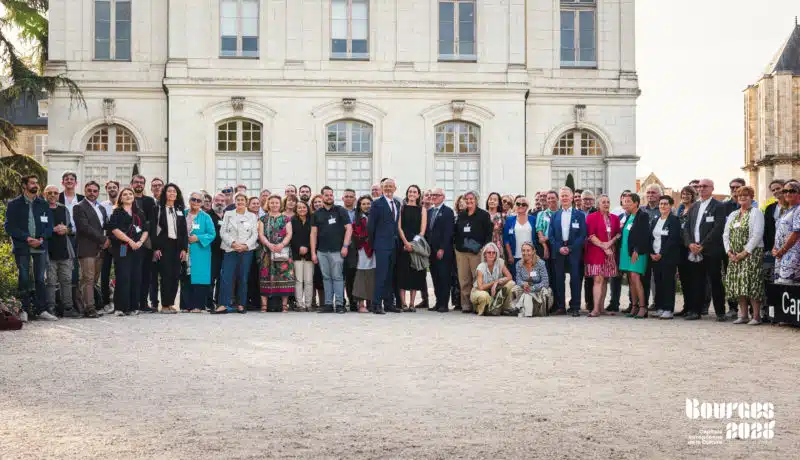
On 11 September, 180 people gathered at the Théâtre Jacques-Cœur for a conversation between Rose Lamy and Nora Hamadi. Their discussion explored, among other things, the boundaries we draw between territories and social experiences, and what can, on the contrary, bring them closer together.
Why bring Rose Lamy and Nora Hamadi together? Because their books, personal journeys and ideas resonate with one another. But above all, because their work is shaped by the same question: what brings us together when media, political and social narratives tend to set us apart?
Territories We Set Against Each Other, Experiences We Share
For Nora Hamadi, coming to Bourges was an opportunity to explore the connections between territories that are often portrayed as worlds apart. She highlighted the limitations of the terms used to describe these places — “the provinces”, “the outskirts”, “rural areas” — which can sometimes end up referring simply to everything outside Paris.
She drew a parallel between the way Bourges and the Berry are perceived and the way working-class neighbourhoods can be viewed. Two types of territory that dominant narratives tend to set against each other, even though their inhabitants may share similar experiences.
“Ultimately, there are more things that connect us than things that divide us.” — Nora Hamadi
Behind these geographical categories, Rose Lamy and Nora Hamadi invite us to look at what shapes individual lives: social backgrounds, family legacies, the circumstances in which we grow up, and experiences that we may share without even realising it.
Putting Social Class Back at the Centre
Throughout the conversation, one concept repeatedly came to the fore: social class.
For Nora Hamadi, it is an essential lens through which to understand the possible connections between people who are often portrayed as belonging to different worlds. “People from the towers” and “people from the small towns” are regularly set against one another, even though their experiences can converge when we look at their social circumstances.
This question also echoes Rose Lamy’s work on class contempt and the pressure to conform to a particular model in order to be accepted. Nora Hamadi connects this experience with other forms of assimilation and integration experienced by people from immigrant backgrounds.
In both cases, the same question emerges: what do we have to give up or change about ourselves in order to find our place in a space that was not originally meant for us?
Meeting to Shift the Narratives
But Ce qui nous lie is not simply about identifying what people have in common. The event is also rooted in the belief that meeting and talking with one another can help us move beyond the categories in which we are placed.
At a time when public debate is often shaped by confrontation, Rose Lamy and Nora Hamadi offer another kind of space: a conversation that takes the time to bring different experiences into dialogue.
Their meeting in Bourges was a case in point. The two speakers share many observations, while coming from different territories and backgrounds. Their conversation showed that this distance can sometimes be less significant than we imagine.
And that common ground can be very tangible: a childhood, cultural references, social experiences, memories… all elements that can create connections where public narratives tend to create distance.
Perhaps this is at the heart of Ce qui nous lie: creating spaces where we take the time to meet, listen to one another and look differently at what we thought we knew about others.
Continuing the Evening with Readers
Moderated by Marie-Claire Raymond, journalist at Le Berry Républicain, the conversation continued in the theatre’s foyer with a book signing with Rose Lamy, the day after the release of the graphic novel En bon père de famille.
An evening centred on discussion, encounters and the connections we sometimes discover where we least expect them.
Thank you to Rose Lamy, Nora Hamadi, Marie-Claire Raymond and the 180 people who attended this special edition of Ce qui nous lie.
 S'inscrire à la newsletter
 Download Bidbook