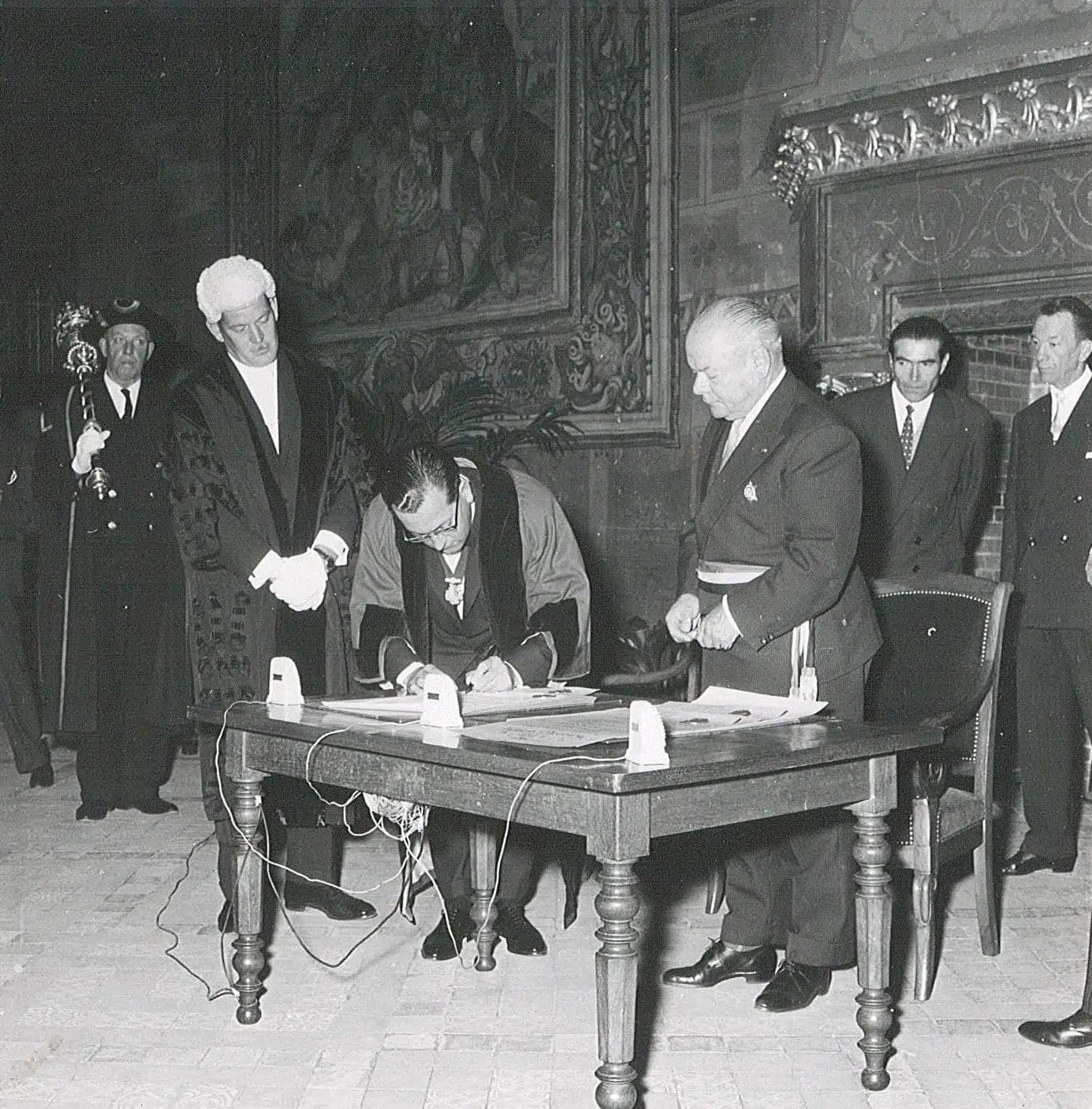
Blois.Twinning ceremony at the Château de Blois.
On June 30, 1963 – 2 Fi_0303
This black-and-white photograph, preserved in the Archives of the City of Blois (series 2Fi), was taken in June 1963 by Jean-François Doré during the signing of the twinning agreement between Blois, Lewes and Waldshut-Tiengen.
It shows representatives of the three cities, including Marcel Bülher on the right, wearing the tricolour sash, then Mayor of Blois.
This twinning formalised bonds of friendship already nurtured through school exchanges. The Twinning Committee—bringing together associations, teachers and journalists—aims to promote cultural exchange and peace in Europe.
Each year, it organises activities, sports and musical events, trips, and student exchanges.
The scene takes place in the Salle des États of the Château de Blois, a symbolic seat of power where the Estates-General met in 1576 and 1588.
Following the ceremony, a meal was held in the Gaston d’Orléans wing, before the inauguration of Lewes Street and Waldshut Street.
The Archives preserve photographs, charters, agreements and documents tracing the development of the twinning over time. Blois is also linked to Azrou, Weimar, Urbino, Cáceres and Sighişoara.
A municipal article from 1972 recalls that in 1971, around 500 residents from Blois and Waldshut travelled the 650 kilometres separating them, strengthening their bonds of friendship.
La Rochelle — signing of the twinning agreement between La Rochelle and Lübeck.
On May 21, 1988 – 40 Fi 1016
In May 1988, during the Quinzaine rochelaise des pays de langue allemande, the cities of Lübeck (Germany) and La Rochelle officially sealed their twinning.
This agreement marked a renewal of exchanges between the two cities—revived since the late 1970s, but rooted in a much older shared history.
From the Middle Ages onward, La Rochelle maintained close ties with the ports of the Baltic Sea, particularly those of the Hanseatic League—a powerful trading network that shaped the economy and politics of Northern Europe for over four centuries.
Between the 13th and 17th centuries, La Rochelle stood out as the only French trading post integrated into this maritime commercial network.
Beyond this historical and economic legacy, the twinning agreement between La Rochelle and Lübeck reflects a shared desire to strengthen bonds of friendship between their citizens and to contribute “to mutual understanding between peoples and the preservation of peace in Europe.”
This partnership aims to deepen and expand exchanges across a wide range of fields, including the economy, culture, education, language learning, science, youth, sport, tourism, and heritage preservation.
In this photograph, Michel Crépeau, Mayor of La Rochelle, and Mr Bouteiller, Mayor of Lübeck, shake hands after signing the twinning agreement, in the presence of Mrs Sommer, President of the City of Lübeck.
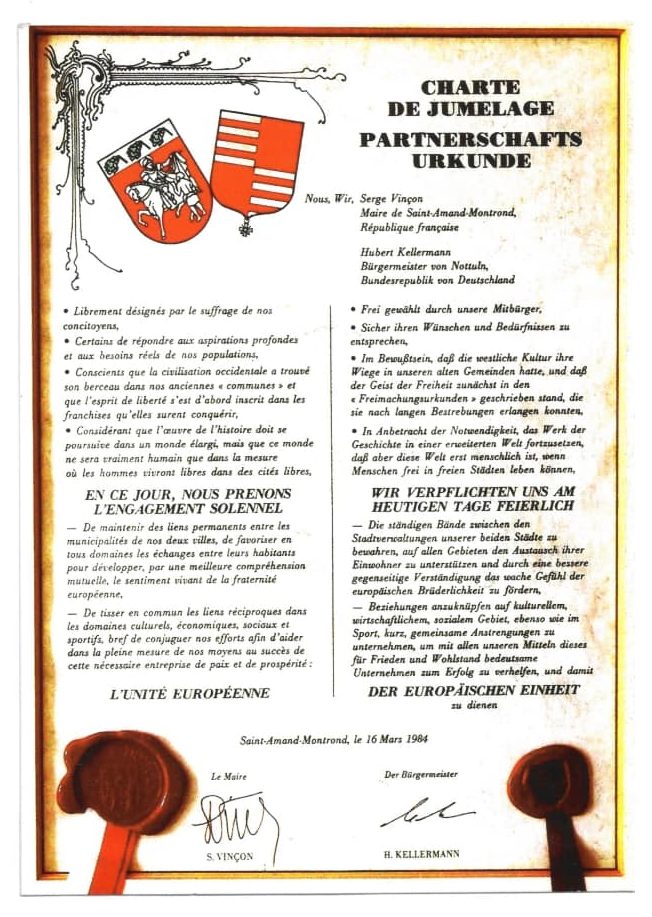
Saint-Amand-Montrond.
In 1984
This archive is a postcard published in 2009 by the Saint-Amand (Central France) / Nottuln (Rhineland) Twinning Committee to mark its 25th anniversary.
The postcard is small in size (10 × 15 cm). It faithfully reproduces, in a reduced format, the original twinning charter (die Partnerschaftsurkunde), featuring the bilingual text, the coats of arms of the twin towns, and the seals placed alongside the signatures.
The charter was signed in 1984 in Saint-Amand-Montrond, and then in Nottuln, by the mayors Hubert Kellermann (Nottuln) and Serge Vinçon (Saint-Amand-Montrond). The choice of words highlights a shared commitment (die Verpflichtung), based on new principles of exchange (der Austausch), friendship (die Freundschaft), and peace in support of European unity (die europäische Einheit).
In his speech at the twinning ceremony, the Mayor of Saint-Amand-Montrond emphasised the initiative taken by the people of Nottuln, who first sent a letter in February 1983, followed by a German delegation. Serge Vinçon concluded his speech on 16 March 1984 with these words (excerpt, p. 4/4):
“Let us support the youth of our two towns, of our two countries, let us support the youth of Europe […]
— Let us enrich one another through our differences;
— Let us build the future together;
— Let us build together a cathedral of enthusiasm, friendship and peace,
Long live Germany,
Long live France,
Es lebe die Liebe zwischen Deutschland und Frankreich (Long live the love between Germany and France).”
Summary
Town twinning, as we know it today, developed during the 1950s. In the aftermath of the Second World War, there was a clear need to rebuild peaceful relations between peoples.
In the aftermath of the Second World War, there was a clear need to rebuild peaceful relations between peoples.
The idea of a union of municipalities—promoted in particular by the Council of European Municipalities and Regions in 1951—embodied the vision of a united and peaceful Europe.
Twinning can take many forms: cultural or festive events, friendly sports competitions, school exchanges… But in every case, as a political act, it involves an official ceremony during which the mayors sign a charter symbolising the bond between the two cities.
The choice of twinning partners may be based on different criteria. Some cities establish partnerships as a clear declaration of post-war reconciliation (such as Saint-Amand-Montrond and Nottuln), while others formalise already existing relationships (like the school exchanges between Blois, Lewes and Waldshut). In some cases, these connections even predate the twinning by several centuries (as with La Rochelle and Lübeck).
Aujourd’hui, de nombreuses villes sont jumelées. Derrière ces jumelages se trouve une histoire riche, que les archives permettent de mieux comprendre. Ces histoires partagées révèlent une volonté commune d’échange et de coopération internationale.