Avignon, place du Palais.Flag-throwing during festivities celebrating the twinning with the Italian city of Siena.
In 1977 – AMA182Fi580/1
Siena, in the Tuscany region, was twinned with Avignon in 1961, following two years of correspondence. The context of the photograph presented here is not well documented. However, notes made by the photographer on the storage envelopes suggest that it captures a performance by a Sienese delegation.
It likely alludes to the Palio, held twice a year in Siena’s vast Piazza del Campo. This medieval horse race is preceded by a grand parade of participants and a flag-throwing display, with each district of the city represented in this highly codified ritual.
Here, the Avignon ceremony takes place in another symbolic open space, at the foot of the Palais des Papes. In the background, the photograph reveals the façade of the Petit Palais museum. Opened in 1976, this museum of medieval art (now known as the Louvre in Avignon) houses works by Italian Primitives from the renowned Campana collection.
The photograph thus highlights, in two ways, the cultural dialogue fostered through twinning initiatives.
Press photographer Maurice Costa (full name Costagliola) joined the Avignon office of Le Provençal in 1955. Between 1950 and 1991, through more than 2,500 assignments representing nearly 40 000 negatives, he captured an exceptionally wide range of subjects, reflecting the diversity of a local newspaper’s coverage.
Rich and of outstanding quality, the Costa collection offers a vivid portrayal of daily life in Avignon, marked by a sharp eye, a keen sense of timing, and strong compositional skill. It was acquired by the City of Avignon for its Archives Department in 2023.
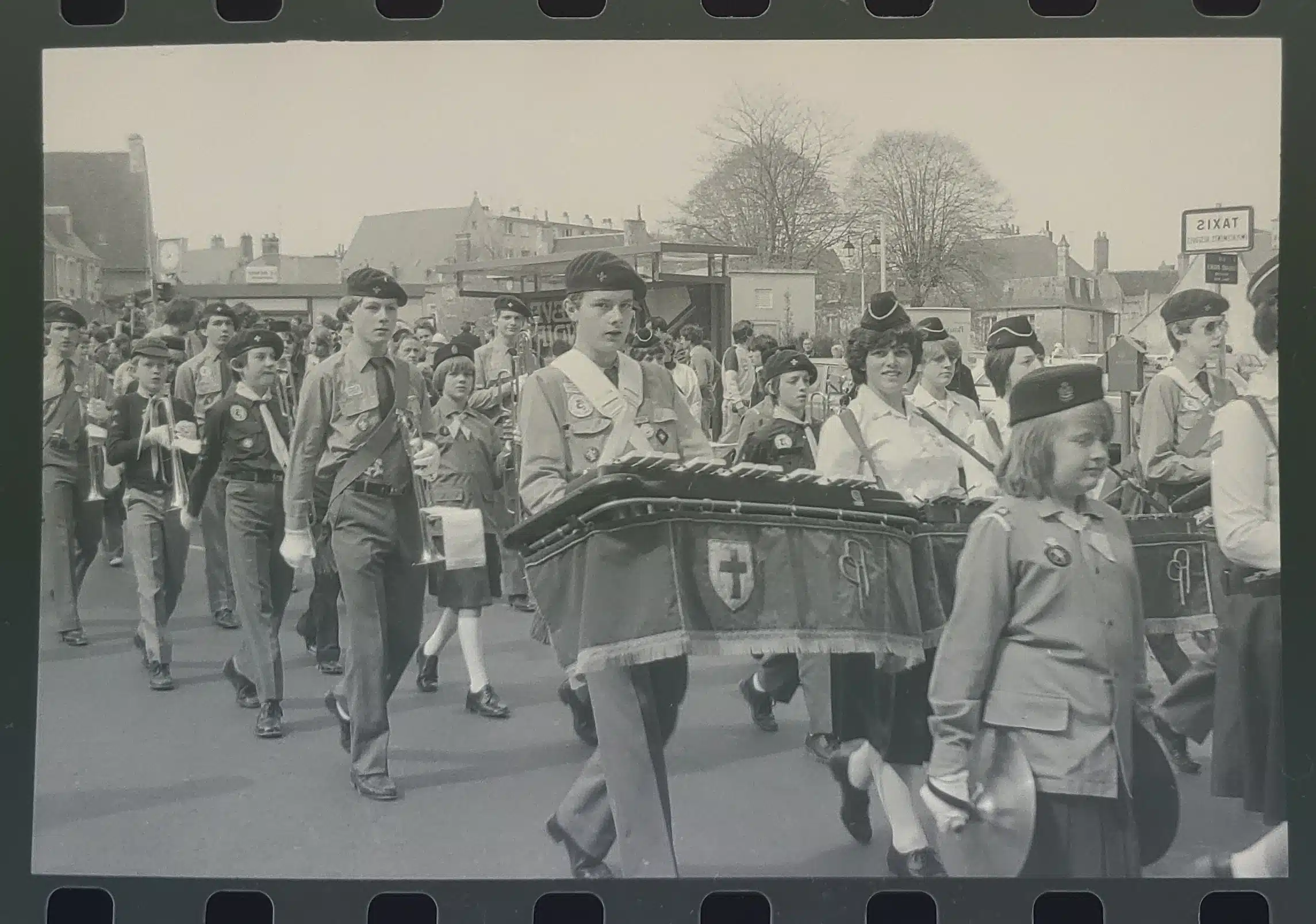
Bourges - brass band of the Peterborough delegation.
In 1982 – 29W7
This negative shows the Peterborough brass band parading through the streets of Bourges, the English town twinned with Bourges since 1957.
From 17 to 25 April 1982, the two mayors-keen to bring the twinning to life beyond formal exchanges-organised a Franco-British Week.
It was a major event in the making: over the course of these few days, nearly 300 people, members of various clubs and associations, travelled from England to visit the residents of Bourges.
“Bourges has, for the past few days, been living on English time.” This phrase sets the tone for a week rich in encounters and festivities.
British associations “exchange with their counterparts in Bourges on a wide range of topics, from social life and culture to leisure and sport.” Numerous celebrations are also organised. To mark the arrival of the English delegation, a brass band of several dozen musicians parades through the streets of the city centre — a moment captured by the photographers of the City of Bourges.
These photographs, including the document shown here, belong to a strictly photographic collection. File 29W7 contains images from numerous twinning visits between 1977 and 1985, but with little more than a brief indication of the city concerned (“Peterborough, 1982”).
Further research makes it possible to place these photographs in context by drawing on other archival collections. In this case, it is the correspondence from the mayor’s office (reference 96W109) that provides insight into the context of this Franco-British Week.
Châteauroux.
On October 15, 1977 – 13W825
The Franco-German twinning agreement between Châteauroux and Gütersloh, signed in Châteauroux on 14 October 1977, brought together at the new City Hall the key figures involved in this partnership.
Among the French representatives were Daniel Bernardet, Mayor of Châteauroux, alongside former prisoners of war who were actively engaged in promoting the twinning through their association: André Payen, André Gasnier and Henri Pasquet. On the German side were Heinz Kollmeyer, Mayor of Gütersloh, Dr Gerd Wixforth, Director of Services, and Fritz Jacobtroweien.
The story began in 1970 within the departmental association of veterans and former prisoners of war of the Indre. This organisation had established ties with its counterpart in Gütersloh, which was keen to explore the possibility of a partnership.
Youth camps were then organised alternately in each country, fostering exchanges and building lasting bonds of friendship. The aim was to get to know one another better in order to build mutual respect, so that younger generations could grow up in a peaceful and thriving Europe.
The day after the official signing, an entire afternoon of musical festivities was organised on Saturday, 15 October 1977.
The event opened on Place de la République, in front of City Hall, with a performance by the Gütersloh high school brass band (Gymnasial-Posaunenchor), before continuing in other parts of the city, including Beaulieu and Saint-Jean. The programme then featured traditional musicians from Les Gâs du Berry, followed by a parade through the city centre with the ESMAT military band and the Majorettes du Berry.
Finally, the municipal band of Châteauroux brought these first official Franco-German exchanges to a close on a musical note-marking the beginning of a long cycle of school, sporting, cultural, community and friendly exchanges.
In this photograph by René Pécherat, the audience gathers on Place de la République, in front of the new City Hall (inaugurated in January 1977), to listen to the young musicians of the Gymnasial Posaunenchor, conducted by Horst Reinkemeier.
Summary
A twinning is more than the signing of an agreement between two municipal teams. Above all, it is a testament to a lasting friendship between two communities.
During the visit of a delegation, it is customary to organise a celebration so that residents can come together and mark this shared bond. These events may take the form of performances, parades, brass bands, or other popular festivities.
These events may be organised for a variety of occasions. The most significant, of course, is the signing of the twinning agreement by the mayors of both cities. Musical celebrations, as in Châteauroux, help to mark the beginning of a lasting bond of friendship-one that is sustained through the regular renewal of such encounters.
This is also the case in Bourges, where a large delegation from Peterborough came to celebrate 25 years of twinning in festive style. These celebrations, designed to bring the two communities closer together, offer associations a valuable opportunity to exchange, express themselves, and share their culture-as illustrated by the Sienese delegation’s flag-throwing performance during its visit to Avignon.
These photographic archives play an essential role in preserving the continuity of twinning relationships. When context is lacking in certain photographic collections, it can be reconstructed by cross-referencing complementary archives, enabling a deeper understanding of the events and their significance.
In this way, the universal practice of twinning allows each city, in its own way, to share its history and culture.