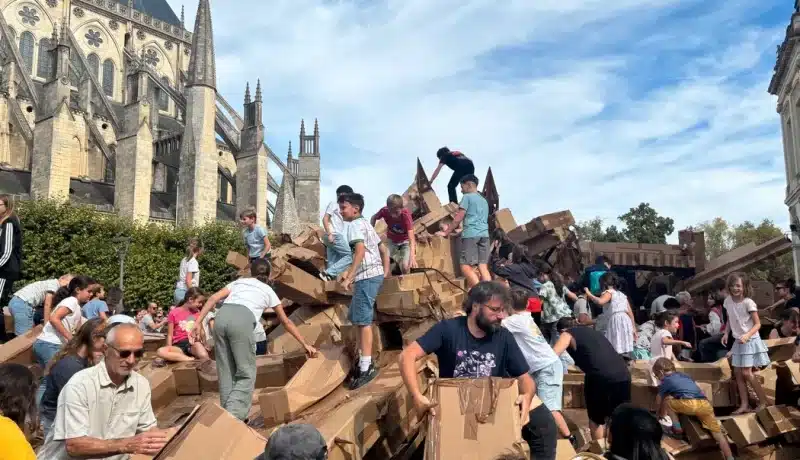
On 24 and 25 September, Bourges hosted the annual Matrix Seminar, bringing together more than 100 participants from 35 European cities and across France. Two days of meetings, discussions and collective work around a shared goal: sharing experiences, strengthening cooperation and imagining the future of the European Capitals of Culture beyond their title year.
What happens when Skopje’s Deputy Mayor for Culture exchanges with the Mayor of Gien? When the Director of Chemnitz 2025 meets the Councillor for Bourges 2028 in Saint-Amand-Montrond? Or when the Kiruna 2029 team discusses architecture with POLAU, Tours’ centre for arts and urban development?
Something very concrete happens: experiences are shared and challenged, ideas circulate, and new forms of cooperation take shape. For two days in Bourges, these encounters brought to life a Europe of culture driven by the people who shape it every day.
A Europe of culture gathered in Bourges
Culture professionals, local authority representatives, European Capitals of Culture teams, institutional partners and European stakeholders came together on 24 and 25 September for the annual Matrix Seminar.
More than 100 participants representing 35 European cities took part in the discussions, alongside delegations from across France, from Béthune to Guingamp, and from Tours to Saint-Amand-Montrond.
Over more than 40 hours of discussions, participants shared their experiences and explored a central question: at a time when cultural policies are under increasing pressure across the continent, how can we join forces to keep creativity alive as close as possible to local communities and citizens?
For the European Capitals of Culture currently underway or yet to come, another question emerged: how can we ensure that the knowledge, projects and partnerships developed during a title year continue to thrive long after it has ended?
From the title year to what comes next: thinking about what remains
The seminar brought together experiences from across Europe, but above all provided an opportunity to work on concrete ways to extend the momentum already set in motion.
Sharing knowledge and expertise, the mobility of artists and cultural professionals, accessibility, the ecological transition, and the legacy of projects: these were among the many topics explored through panel discussions, workshops and working sessions.
Several projects and initiatives also contributed to the discussions, including Next Stage Europe, EVEREST, LICIA and the Pass Culture, with the aim of sharing tools and pilot initiatives that can be replicated across different territories.
The discussions also focused on the future of the title and on ways to preserve, beyond 2033, the cooperation and learning dynamics developed by the European Capitals of Culture.
Making cooperation a tool for transformation
With the European Commission, the ECoC Family, Culture Next, ECoC Echo and several European Capitals of Culture in attendance, the European dimension was at the heart of the seminar.
But it was above all embodied in the exchanges between participants: one city sharing a method with another, one team passing on experience gained during its title year, and professionals identifying new opportunities for cooperation.
This is also the role of the Matrix: a space for meeting, a laboratory for cooperation and a platform for experimentation, where cities can learn from one another, build together and reflect on what remains once the title year is over.
In Bourges, these two days thus helped identify concrete avenues for sharing knowledge and expertise, improving accessibility, advancing the ecological transition, facilitating the mobility of artists and cultural professionals, and ensuring the legacy of projects.
A momentum set to continue
Thank you to all the delegations and participants for their presence and contributions, and to Laurence Tison-Vuillaume, President of Pass Culture, for joining us.
Our thanks also go to Villa Monin for hosting us, and to Toute l’Europe, our media partner, for its support and commitment alongside us.
The Matrix now continues its work: sharing experiences, bringing territories closer together and collectively shaping the next chapters of Europe’s cultural story.
 S'inscrire à la newsletter
 Download Bidbook