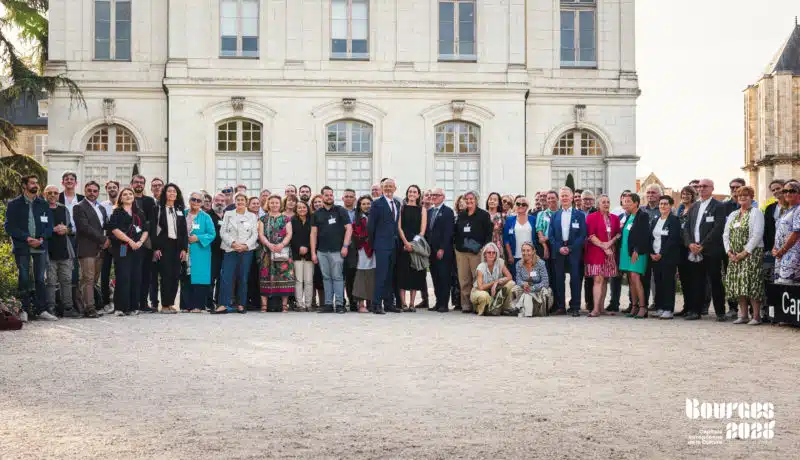
This week, from 21 to 23 April, Bourges hosted the annual General Assembly of NECSTouR, a leading European network dedicated to developing more sustainable and responsible tourism. More than 100 professionals from 11 European countries gathered to explore a shared challenge: rethinking the links between culture, tourism and local areas, from creation to legacy.
Through this major gathering, Bourges 2028 and the Centre-Val de Loire Region are reaffirming a clear ambition: to make the alliance between tourism and culture a driver of sustainable transformation, serving both residents and visitors. This ambition builds on existing strengths across the region, including one of France’s most developed cycling tourism networks, with more than 3,400 km of dedicated routes helping to reinvent the way people discover the region.
Making Bourges an Open-Air European Laboratory
For several days, Bourges became a real-life testing ground. Members of the network explored the city, discovered local initiatives and shared their practices. Together, they questioned existing models and explored new ways of travelling, creating and welcoming visitors, particularly through softer, low-carbon forms of mobility.
The programme included visits to several emblematic sites across the region, including Noirlac Abbey, as well as presentations of the transformation projects underway at the Halle au Blé, the Hôtel-Dieu and the Palais Jacques Cœur. These visits offered a concrete insight into the changes taking place in Bourges and across the region.
This momentum is fully aligned with the Bourges 2028 project, which goes far beyond the scope of a cultural event.
As Pascal Keiser, General Commissioner of Bourges 2028, explained during his presentation of the future European Capital of Culture:
“Bourges 2028 is not simply an event-based finish line, but the starting point for a profound transformation of our local area. We are not creating a temporary event, but building local alliances and connections […] to develop a pioneering model based on cultural reach and care for the living world, with innovative low-carbon mobility strategies at the heart of the project, recognised by the European jury.”
Rethinking the Tourism of Tomorrow
At the heart of the discussions was the need to act now to build a tourism model that is more respectful of the planet and local communities.
At Bourges 2028, this ambition is being translated into concrete action. From the visitor journey – from the moment they set off to their arrival at the train station – to the transformation of spaces into places for experience and creation, every aspect is designed to reduce the carbon footprint and inspire new ways of experiencing the region.
The Bourges 2028 project therefore promotes a vision of slow tourism that extends across the entire region. By highlighting lesser-known routes and bringing natural and heritage sites back into use, it helps distribute visitor flows more evenly while revealing the richness of the Centre-Val de Loire region.
Building a Lasting Legacy
NECSTouR’s General Assembly is helping to strengthen this collective momentum. It connects Bourges 2028 with a committed European network and contributes to developing concrete solutions designed to last.
Because the challenge goes far beyond the 2028 event: it is about building a tangible legacy for the local area from today onwards.
A legacy where cultural reach goes hand in hand with greater care for the living world, where innovation drives the transition, and where tourism becomes a driver of a more resilient local economy.
In Bourges, the future of sustainable tourism is no longer a promise. It is already taking shape.
Photo credit: Lydia Descloux
 S'inscrire à la newsletter
 Download Bidbook