Avignon, Place du Palais - flag-throwing during festivities celebrating the twinning with the Italian city of Siena, 1977. Photograph: flexible negative, Maurice Costa. Archives of the City of Avignon - 182Fi580/1.
Avignon, place du Palais.
Flag-throwing during festivities celebrating the twinning with the Italian city of Siena.
In 1977 – AMA182Fi580/1
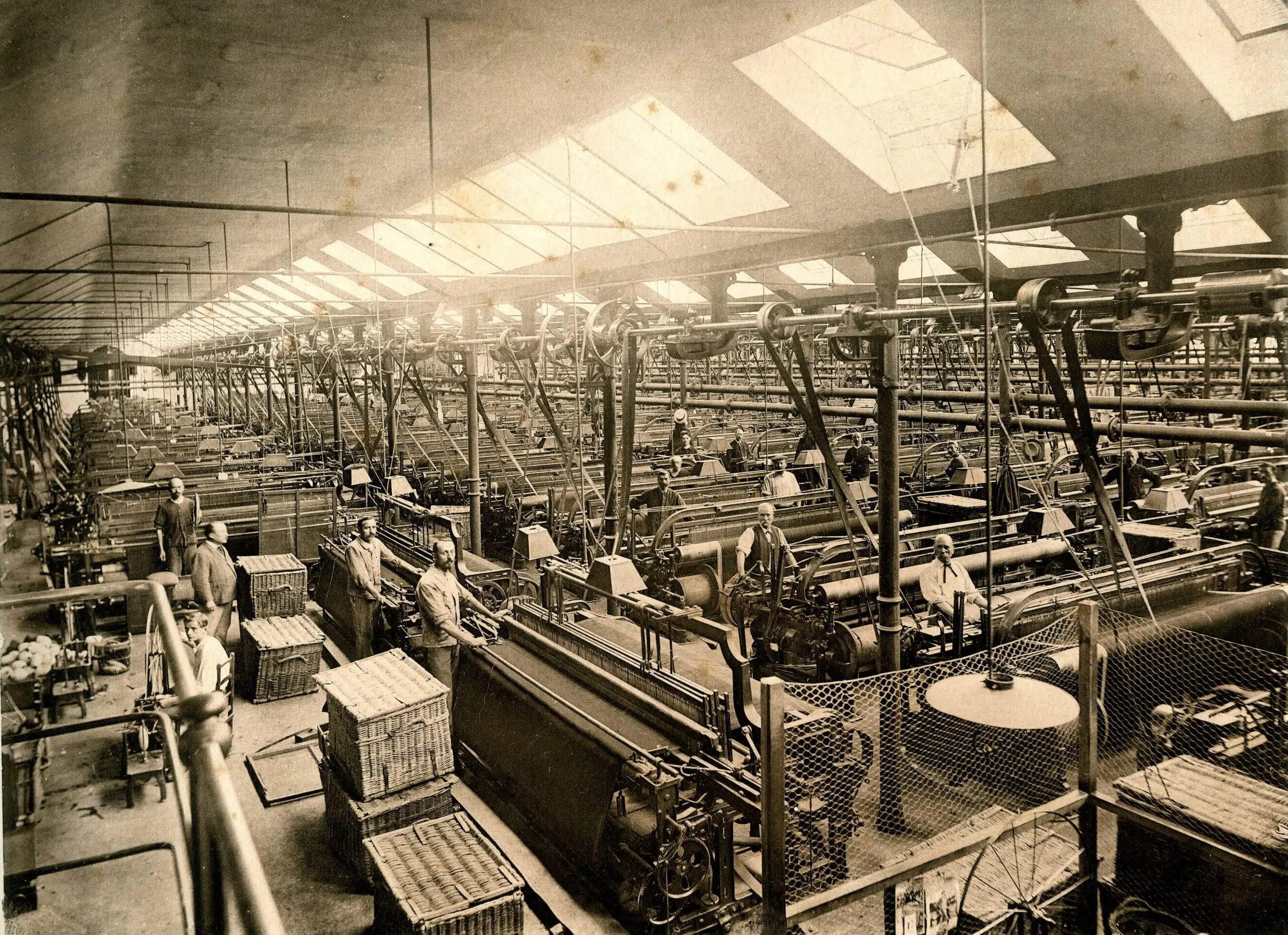
La manufacture de draps Balsan représente un ensemble industriel emblématique du XIXᵉ siècle, indissociable de l’histoire drapière de Châteauroux, implantée depuis le Moyen Âge dans la vallée de l’Indre. Cette usine d’ampleur, construite à l’initiative de Pierre Balsan de 1861 à 1869 sur un site de 40 ha, est l’œuvre de l’architecte castelroussin Alfred Dauvergne, qui venait déjà de livrer une des plus grandes usines de France, la Manufacture des tabacs, qui servira de modèle en France pour la Régie nationale. Devenue en 1912 “Société Anonyme des Établissements Balsan », elle fabrique alors principalement du drap cardé destiné à la conception d’uniformes dont le célèbre « bleu horizon » des poilus de la Grande Guerre. Après le déclin progressif des activités industrielles amorcé dans la seconde moitié du XXe siècle, les établissements Balsan furent partiellement démantelés avant d’être rachetés par la Ville de Châteauroux en 1988. Dès les années 1990, la municipalité a entrepris un vaste projet de reconversion urbaine. Les orientations de ce programme sont sensiblement modifiées en 1996, à la suite de l’inscription de l’ancienne manufacture, des châteaux Tour et Rivière ainsi que de leurs annexes à l’inventaire supplémentaire des monuments historiques. Le site constitue aujourd’hui un espace patrimonial remarquable en pleine reconversion, situé aux abords immédiats des milieux naturels protégés longeant les rives de l’Indre. Cette photographie de Jules Dorsand (1851-1935) est issue d’un reportage, réalisé en 1910 pour le cinquantième anniversaire de l’établissement, commandé par les Etablissements Balsan pour faire la promotion de cette usine d’une grande modernité et en faire connaître tout le processus de production par atelier. Les clichés de ce reportage seront largement diffusés sous forme de cartes postales.
Carte postale ancienne non datée – J. Alary édit. Châteauroux. Copie issue du fonds Jean-Claude Portrait – Archives municipales de Châteauroux.
Le Poinçonnet. Famille de charbonniers devant leur Loge.
In 1982 – 29W7
This negative shows the Peterborough brass band parading through the streets of Bourges, the English town twinned with Bourges since 1957.
From 17 to 25 April 1982, the two mayors-keen to bring the twinning to life beyond formal exchanges-organised a Franco-British Week. It was a major event in the making: over the course of these few days, nearly 300 people, members of various clubs and associations, travelled from England to visit the residents of Bourges.
“Bourges has, for the past few days, been living on English time.” This phrase sets the tone for a week rich in encounters and festivities. British associations “exchange with their counterparts in Bourges on a wide range of topics, from social life and culture to leisure and sport.” Numerous celebrations are also organised. To mark the arrival of the English delegation, a brass band of several dozen musicians parades through the streets of the city centre — a moment captured by the photographers of the City of Bourges.
These photographs, including the document shown here, belong to a strictly photographic collection. File 29W7 contains images from numerous twinning visits between 1977 and 1985, but with little more than a brief indication of the city concerned (“Peterborough, 1982”). Further research makes it possible to place these photographs in context by drawing on other archival collections. In this case, it is the correspondence from the mayor’s office (reference 96W109) that provides insight into the context of this Franco-British Week.
Fonds Claude Richoux, document non daté, acquisition septembre 2021
Vierzon. L’industrie à Vierzon.
99_FI_42_006, La Fonderie et le Bassin de l’Yèvres
En 1776, le comte d’Artois, frère du roi Louis XVI, devient apanagiste du domaine royal de Vierzon. Pour faire fructifier son importante forêt, ses administrateurs lui proposent de créer une « grosse forge » à l’Est de la ville. L’eau de l’Yèvre comme force motrice, le bois comme combustible et le minerais de Sologne augurent une industrialisation précoce de Vierzon, avant la Révolution française. Tournée vers l’armement pendant l’Empire, de nouveaux débouchés sont trouvés : plaques d’acier pour les chantiers navals, rails pour le chemin de fer qui se développe. Elle sera radicalement transformée en 1852, devenant une tréfilerie pointerie qui perdurera jusqu’en 1978, année de sa fermeture.
Summary
A twinning is more than the signing of an agreement between two municipal teams. Above all, it is a testament to a lasting friendship between two communities. During the visit of a delegation, it is customary to organise a celebration so that residents can come together and mark this shared bond. These events may take the form of performances, parades, brass bands, or other popular festivities.
These events may be organised for a variety of occasions. The most significant, of course, is the signing of the twinning agreement by the mayors of both cities. Musical celebrations, as in Châteauroux, help to mark the beginning of a lasting bond of friendship-one that is sustained through the regular renewal of such encounters. This is also the case in Bourges, where a large delegation from Peterborough came to celebrate 25 years of twinning in festive style. These celebrations, designed to bring the two communities closer together, offer associations a valuable opportunity to exchange, express themselves, and share their culture-as illustrated by the Sienese delegation’s flag-throwing performance during its visit to Avignon.
These photographic archives play an essential role in preserving the continuity of twinning relationships. When context is lacking in certain photographic collections, it can be reconstructed by cross-referencing complementary archives, enabling a deeper understanding of the events and their significance. In this way, the universal practice of twinning allows each city, in its own way, to share its history and culture.
 S'inscrire à la newsletter
 Download Bidbook