March 2026

Les Archives de la Matrice

Voir toutes les archives

WhatsApp Image 2026-08-12 at 10.54.57
Avignon, Place du Palais - flag-throwing during festivities celebrating the twinning with the Italian city of Siena, 1977. Photograph: flexible negative, Maurice Costa. Archives of the City of Avignon - 182Fi580/1.

Avignon, place du Palais.
Flag-throwing during festivities celebrating the twinning with the Italian city of Siena.

In 1977 – AMA182Fi580/1

Siena, in the Tuscany region, was twinned with Avignon in 1961, following two years of correspondence. The context of the photograph presented here is not well documented. However, notes made by the photographer on the storage envelopes suggest that it captures a performance by a Sienese delegation.
It likely alludes to the Palio, held twice a year in Siena’s vast Piazza del Campo. This medieval horse race is preceded by a grand parade of participants and a flag-throwing display, with each district of the city represented in this highly codified ritual.
Here, the Avignon ceremony takes place in another symbolic open space, at the foot of the Palais des Papes. In the background, the photograph reveals the façade of the Petit Palais museum. Opened in 1976, this museum of medieval art (now known as the Louvre in Avignon) houses works by Italian Primitives from the renowned Campana collection.
The photograph thus highlights, in two ways, the cultural dialogue fostered through twinning initiatives.

Press photographer Maurice Costa (full name Costagliola) joined the Avignon office of Le Provençal in 1955. Between 1950 and 1991, through more than 2,500 assignments representing nearly 40 000 negatives, he captured an exceptionally wide range of subjects, reflecting the diversity of a local newspaper’s coverage.
Rich and of outstanding quality, the Costa collection offers a vivid portrayal of daily life in Avignon, marked by a sharp eye, a keen sense of timing, and strong compositional skill. It was acquired by the City of Avignon for its Archives Department in 2023.

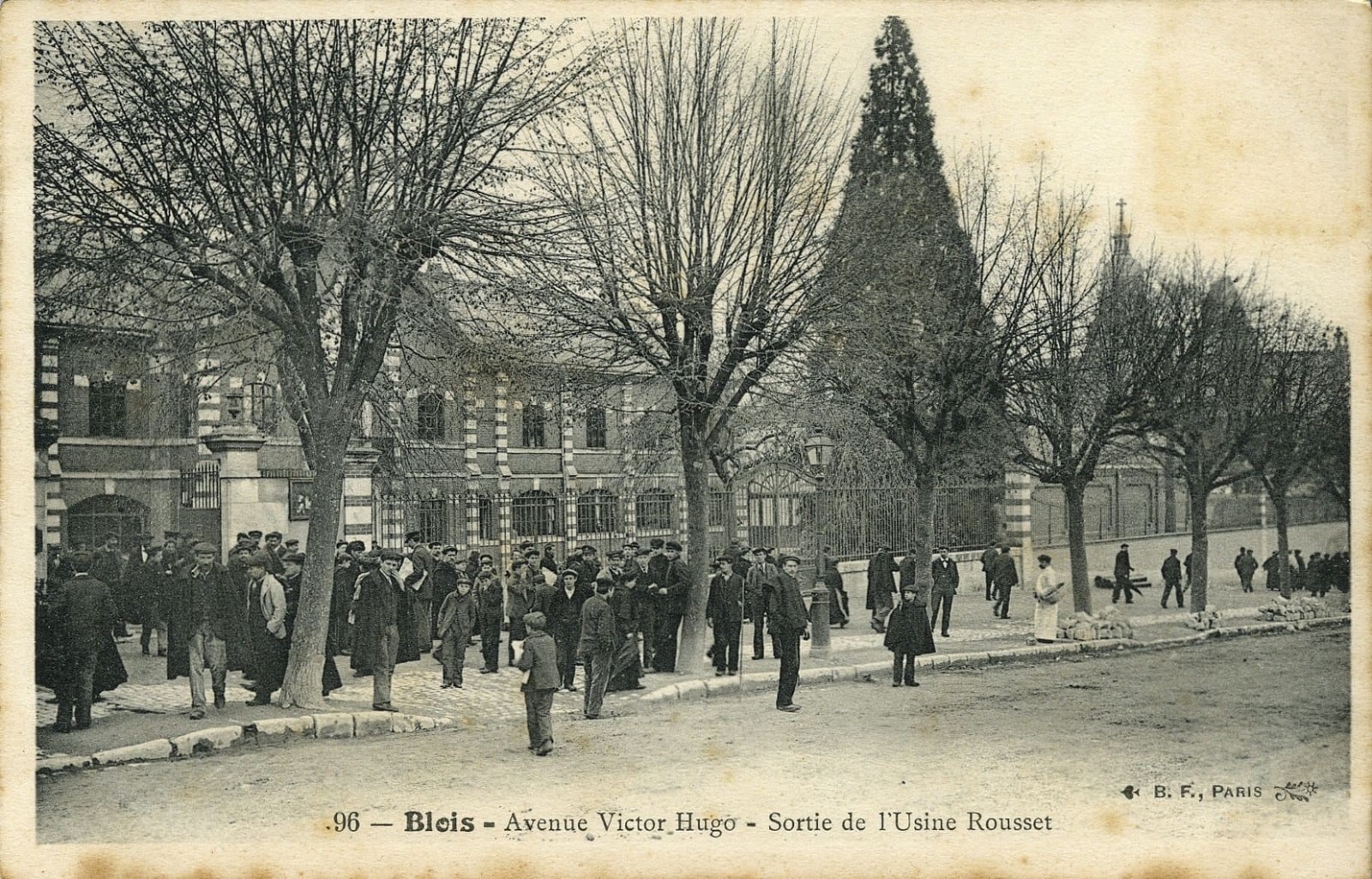
WhatsApp Image 2026-08-12 at 10.54.57 blois
Ouvriers sortant de la fabrique de chaussures Rousset, située au 5 avenue Victor Hugo à Blois, carte postale, Berthaud frères éditeurs, Paris

Blois, Sortie de l’usine Rousset, avenue Victor-Hugo

In 1982 – 29W7

This negative shows the Peterborough brass band parading through the streets of Bourges, the English town twinned with Bourges since 1957.

From 17 to 25 April 1982, the two mayors-keen to bring the twinning to life beyond formal exchanges-organised a Franco-British Week.
It was a major event in the making: over the course of these few days, nearly 300 people, members of various clubs and associations, travelled from England to visit the residents of Bourges.

“Bourges has, for the past few days, been living on English time.” This phrase sets the tone for a week rich in encounters and festivities.
British associations “exchange with their counterparts in Bourges on a wide range of topics, from social life and culture to leisure and sport.” Numerous celebrations are also organised. To mark the arrival of the English delegation, a brass band of several dozen musicians parades through the streets of the city centre — a moment captured by the photographers of the City of Bourges.

These photographs, including the document shown here, belong to a strictly photographic collection. File 29W7 contains images from numerous twinning visits between 1977 and 1985, but with little more than a brief indication of the city concerned (“Peterborough, 1982”).
Further research makes it possible to place these photographs in context by drawing on other archival collections. In this case, it is the correspondence from the mayor’s office (reference 96W109) that provides insight into the context of this Franco-British Week.

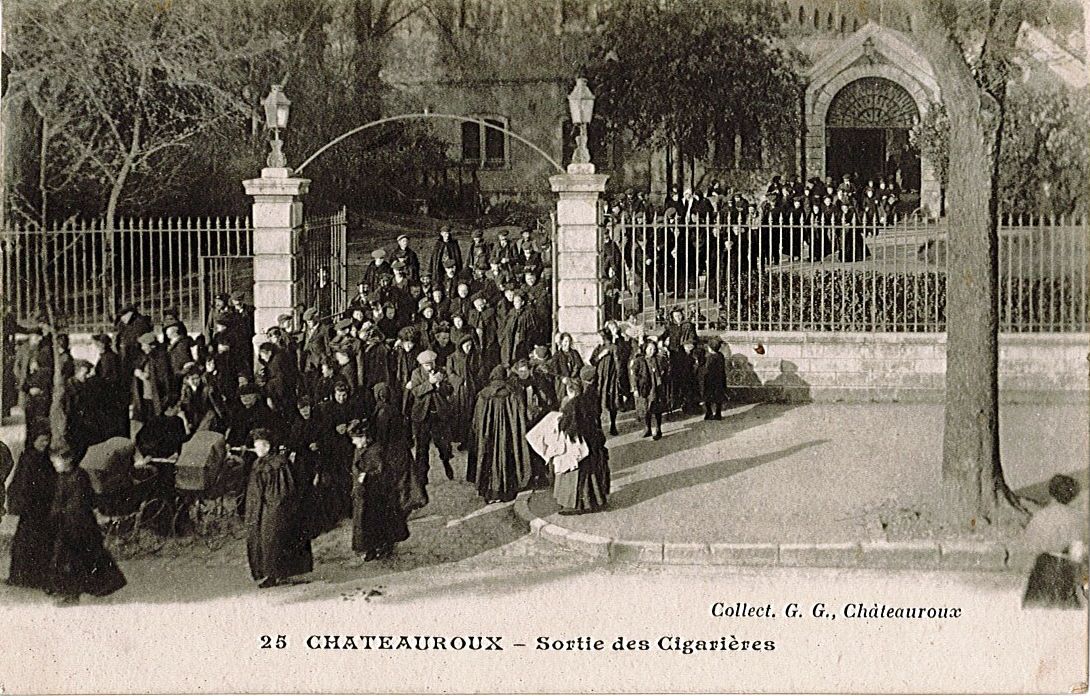
WhatsApp Image 2026-08-12 at 10.54.58çhate
Manufacture des Tabacs. Sortie des cigarières. Photo : G. Guillemont – v. 1910

Châteauroux - Manufacture des Tabacs

En 1910 – 48Fi1421

De 1857 à 1998, la Manufacture des tabacs de Châteauroux a été l’un des fleurons industriels qui a marqué la vie des castelroussins.

Avant de confirmer la construction d’une manufacture à Châteauroux, l’administration de la Régie nationale a mis en œuvre en 1857 des ateliers provisoires qui employèrent déjà 800 ouvrières.

Le comte Eugène de Bryas, député de l’Indre, interviendra énergiquement pour promouvoir dès 1853, l’installation d’une nouvelle manufacture des tabacs à Châteauroux. L’architecte castelroussin, Alfred Dauvergne (1824-1885) est l’artisan de cet édifice qui servira de modèle aux futures constructions de la Régie nationale des Tabacs.

Châteauroux est alors favorisée par l’arrivée en 1847 d’une ligne de chemin de fer (Paris-Orléans-Toulouse) qui promet une large diffusion régionale et nationale de la production de la Régie. Répartie sur 3 hectares, à proximité de la voie ferrée, la construction des 9 bâtiments de cet immense chantier commencé en 1858, se terminera à la fin de l’année 1861.

Plus de 1500 ouvrières (90% des effectifs) étaient ainsi employées à la fabrication des cigares, dans les années 1880. Engagées très jeunes et soumise à un long et difficile apprentissage, elles effectuaient toutes les opérations, depuis la préparation des feuilles de tabac jusqu’à l’empaquetage des cigares et de la poudre à priser, dans de vastes ateliers occupant 200 à 300 ouvrières.

La principale production de la Manufacture était le cigare jusqu’en 1951. Autre production, le « Scaferlati », tabac finement haché à partir d’un mélange de feuilles de différentes provenances. Ce paquet de tabac « gris » fut longtemps le plus demandé des produits de la Manufacture qui cessa sa production en 1952, pour se consacrer exclusivement à la fabrication de cigarettes.

Spécialisée dans la fabrication des cigarettes brunes, notamment des fameuses « Gauloises » et « Gitanes », elle va subir la baisse de la consommation de ces produits au profit des cigarettes blondes américaines. Le site sera fermé en 1998.

Aujourd’hui le site a été reconverti en un pôle tertiaire (Centre Colbert).


Cette photo est issue du fonds de la collection de 10 000 cartes postales de Jean-Claude Portrait léguée aux Archives de la Ville de Châteauroux en avril 2022. 

Summary

A twinning is more than the signing of an agreement between two municipal teams. Above all, it is a testament to a lasting friendship between two communities.
During the visit of a delegation, it is customary to organise a celebration so that residents can come together and mark this shared bond. These events may take the form of performances, parades, brass bands, or other popular festivities.


These events may be organised for a variety of occasions. The most significant, of course, is the signing of the twinning agreement by the mayors of both cities. Musical celebrations, as in Châteauroux, help to mark the beginning of a lasting bond of friendship-one that is sustained through the regular renewal of such encounters.
This is also the case in Bourges, where a large delegation from Peterborough came to celebrate 25 years of twinning in festive style. These celebrations, designed to bring the two communities closer together, offer associations a valuable opportunity to exchange, express themselves, and share their culture-as illustrated by the Sienese delegation’s flag-throwing performance during its visit to Avignon.


These photographic archives play an essential role in preserving the continuity of twinning relationships. When context is lacking in certain photographic collections, it can be reconstructed by cross-referencing complementary archives, enabling a deeper understanding of the events and their significance.
In this way, the universal practice of twinning allows each city, in its own way, to share its history and culture.